KEY TAKEAWAYS
- One card checker supports every major brand.
- Format/expiry checks are free; status checks confirm live/dead.
- Bulk lists stream results; the API automates workflows.
- Only classified checks are billed.
- Deduplicate and validate before any paid card checking request.
- A 50-card pilot removes most card checking surprises for cents.
A card checker tells you whether a credit or debit card is active before you rely on it. This platform checks any brand — Visa, Mastercard, Amex, Discover, JCB, UnionPay, Diners and Maestro — through tuned gateways and returns live, dead, unknown or error in seconds.
What you can check
- Format: Luhn checksum, length and brand range — free and instant with the Luhn validator.
- Expiry and security code shape: see the expiry checker and CVV checker guides.
- Status: live verification through the CC checker / CCN checker engine — the only way to know the account is chargeable.
Card checker for every workflow
- Bulk lists: paste thousands of cards and stream results — see bulk CC checker.
- Automation: the REST API returns structured results per check.
- Merchants: clean stored cards before billing runs — merchant card validation.
- Developers: sandbox testing, validators and integrations — testing safely.
Brand-specific checkers
Each network has its own format quirks (Amex is 15 digits with a 4-digit code; Diners often 14; Maestro ranges 12–19). Dedicated pages: Visa, Mastercard, Amex, Discover, JCB, UnionPay, Diners, Maestro.
Cost
Checking is prepaid (BTC/LTC) and billed per classified result — errors are free. Deduplicate lists to lower cost per useful result; the math is in cost per classified card.
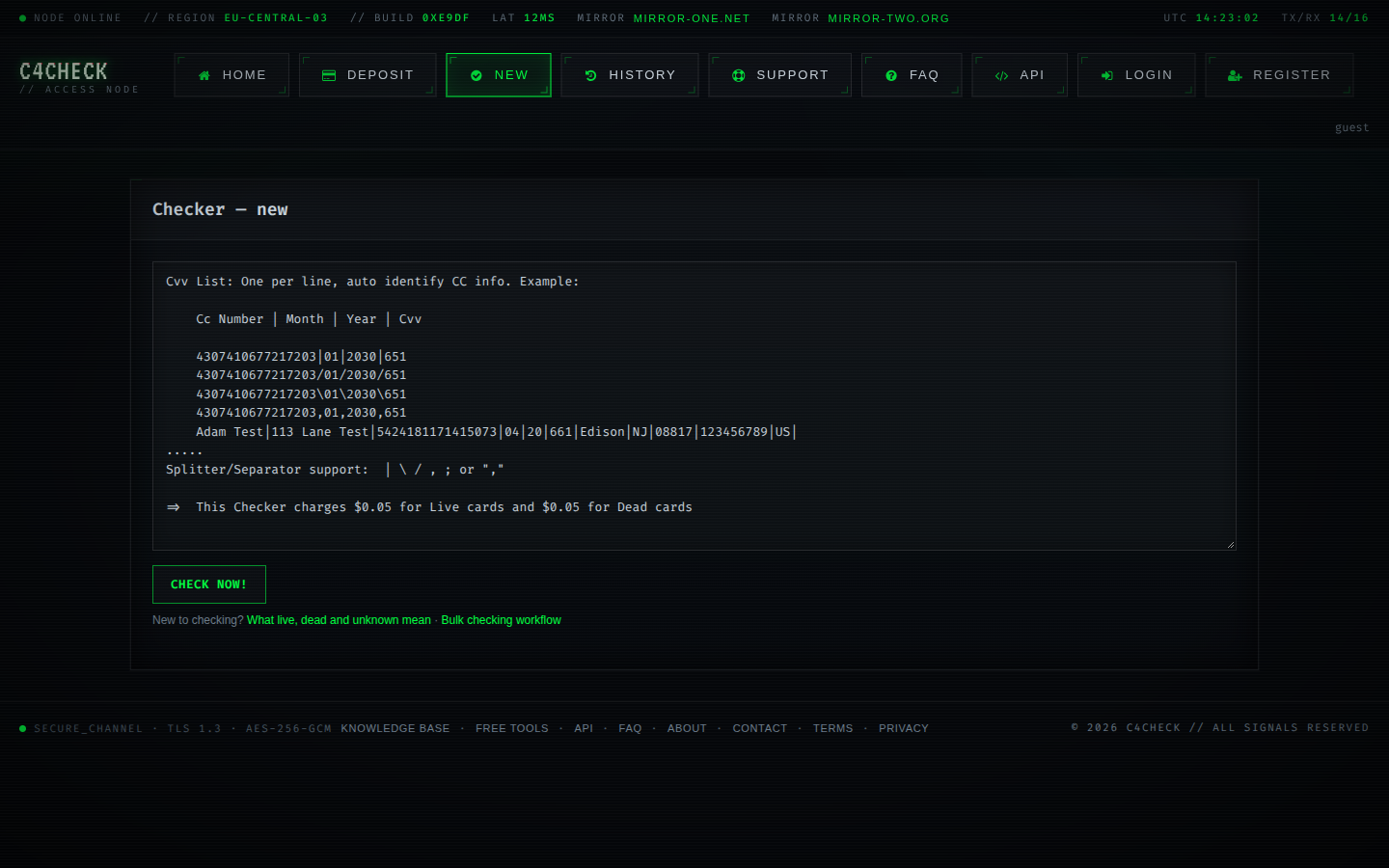
A card checker verifies whether a card account is active and chargeable, returning one of four classifications. This platform's checker works in the browser and through a REST API, with per-gateway routing, streaming results, and history that records cost and outcome for every request.
The honest framing of the category: a check is a signal, not a guarantee. What separates good operators is what they do with each result class — and that is what the guides here are about.
Key points about card checking
- Browser and API access to the same engine
- Per-gateway routing with fallback
- Classification-based billing; errors free
- Complete per-check history and audit trail
Card checking: from request to result
Live means the issuer answered and the account is active and chargeable at that moment; it is strong evidence, not a promise about a future charge. Unknown means no definitive answer was received — often an issuer challenge or soft decline — so the card remains unclassified and deserves at most one fallback pass. Rate limits, formats and latency all come from the provider side, which is why per-gateway configuration exists instead of one global setting. A check sends an authorization-shaped request through a provider to the issuer and classifies the reply into one of four states: live, dead, unknown or error. That single habit separates routine card checking from expensive card checking.
A verification answer reflects the issuer's view at the moment of the request; nothing about it changes the card, the account or the cardholder. A check sends an authorization-shaped request through a provider to the issuer and classifies the reply into one of four states: live, dead, unknown or error. Nothing in the check moves money: the request asks a question, the issuer answers, and the platform records one of four outcomes against your account. Holding that line is what makes card checking reliable over time.
Putting card checking to work
Keep a small balance buffer so an interrupted run never leaves a half-classified list and the temptation to re-check everything. Watch two numbers over time: the classified rate and the error rate. Together they explain almost every surprise in monthly spend. Deduplicate before submitting: the same card in a list twice is billed twice if both copies classify. When results look wrong, diagnose in order: input format, route, provider health, and only then the cards themselves. Holding that line is what makes card checking reliable over time.
Interpreting outcomes in card checking
The four result classes are a decision matrix, not a score: live proceeds, dead recovers, unknown gets one careful retry, error returns to the queue. A live answer is evidence about the account, not a guarantee about a specific future transaction; issuer rules can change between the check and the charge. Dead results are conclusive for the moment and should never be re-checked in the same run; retries on dead cards spend balance for identical answers. Conflating outcomes is the most expensive habit in this area — an error treated as a dead card discards real inventory, and an unknown treated as live inflates confidence. Holding that line is what makes card checking reliable over time.
Keeping card checking predictable
Track cost per classified card rather than cost per request; it is the only metric that reflects retries and unknown rates. Reconcile spend monthly against classified results; the difference between the two numbers is where retries hide. Treat provider outages as routing problems: switch routes, recover the unclassified remainder, keep the answers you already paid for. Keep one primary gateway and one fallback, and switch on evidence — error spikes and classified-rate drops — rather than on price alone. That distinction is what keeps card checking decisions clean.
What card checking cannot promise
Verification is a signal, not a guarantee: a live result does not promise that a later charge will be approved. High-value decisions deserve fresh checks; stale results drift as accounts change. Results describe the account, never the person; they should inform routing and risk decisions, not identity decisions. In card checking work, that is the difference between a signal and a guess.
Funding and costs around card checking
The real cost metric is cost per classified card, because it folds in retries and unknown rates. A small buffer in the balance buys continuity; running to zero mid-list buys a mess. History records cost and before/after balance for every check, making spend auditable at the individual row. A deposit address is generated per invoice, and confirmation progress is visible in real time on the deposit page. In card checking work, that is the difference between a signal and a guess.
Keeping card checking secure
Regenerate the key the moment compromise is suspected; every check remains attributed in history, so the audit trail survives. Verification data is operational data — treat it with the same care as any other sensitive business record. Aggregate statistics are computed without exposing individual records, which is why published numbers can be useful without being risky. Check inputs are account-scoped and retained under the platform retention window, then purged by the scheduled cleanup. The habit costs nothing and removes a recurring class of mistakes.
Benchmarks and distribution for card checking
The reference BIN table covers hundreds of thousands of issuer ranges, and it is deliberately separate from account-status data: one describes issuers, the other describes cards. Latency percentiles matter more than averages: the p90 and p99 tell you what a slow run actually feels like. Aggregate numbers describe populations, not individual cards. Use them to size timeouts and retry budgets, never to judge one account. When the classified rate moves, the cause is usually a route or provider change rather than the underlying cards. Holding that line is what makes card checking reliable over time.
Pitfalls that cost money in card checking
Validating after the paid card checking request, rather than before, doubles the cost of bad input. Storing card data beyond the needs of card checking creates risk without adding value. Treating a card checking snapshot as permanent truth overstates what verification can promise.
- Comparing card checking routes on list price instead of classified rate hides the real economics.
- Ignoring the p90 latency of card checking leads to timeouts that look like provider faults.
- Scheduling card checking after the decision it informs removes most of its value.
- Storing card data beyond the needs of card checking creates risk without adding value.
What card checking cannot promise
Verification is a signal, not a guarantee: a live result does not promise that a later charge will be approved. Results describe the account, never the person; they should inform routing and risk decisions, not identity decisions. Where a check is used inside a payment flow, it complements authorization rather than replacing it. Keep it in mind whenever card checking results are reviewed.
Validation helpers for card checking
Every browser tool runs client-side: input never leaves the page, which keeps format validation free and private. The Luhn validator and expiry checker catch format problems before any paid request leaves the browser. BIN search and IIN lookup answer the issuer question — brand, type, bank, country — without touching account status. Write it down; card checking workflows live and die on small consistencies.