KEY TAKEAWAYS
- JCB uses 3528–3589 with 16–19 digits.
- Security code: 3 digits (back).
- Format checks are free; live status needs an issuer check.
- Validate locally first to avoid spending checks on bad rows.
- Cost per classified card is the only honest price metric for JCB card checking.
- AVS adds a second dimension where the route supports it.
Every network has its own number format — JCB included. This page covers the format facts you need for correct validation, and how to verify live status beyond the format.
JCB format at a glance
| Property | Value |
|---|---|
| Prefix / IIN ranges | 3528–3589 |
| Number length | 16–19 digits |
| Security code | 3 digits (back) |
| Checksum | Luhn (mod 10) |
What is specific about JCB
- JCB is the dominant Japanese network and is accepted worldwide through its own and partner networks.
- The 3528–3589 prefix range is why JCB numbers never collide with Amex (34/37) or other 3-prefix issuers.
- Cross-border JCB acceptance depends on the acquirer; verification status reflects the issuer side, not acquirer coverage.
Validating and verifying
Bulk JCB lists
JCB is a Japanese network with a strong domestic footprint and partner-based reach elsewhere. In verification terms that means high confidence inside Japan and more variance outside it, where responses depend on the provider's routing arrangements. Prefixes run 3528–3589.
Plan for a higher unknown rate on cross-border JCB traffic and give unknowns a deliberate fallback pass rather than reading them as negatives. Coverage confirmation before a bulk run is the single most useful check.

JCB verification specifics
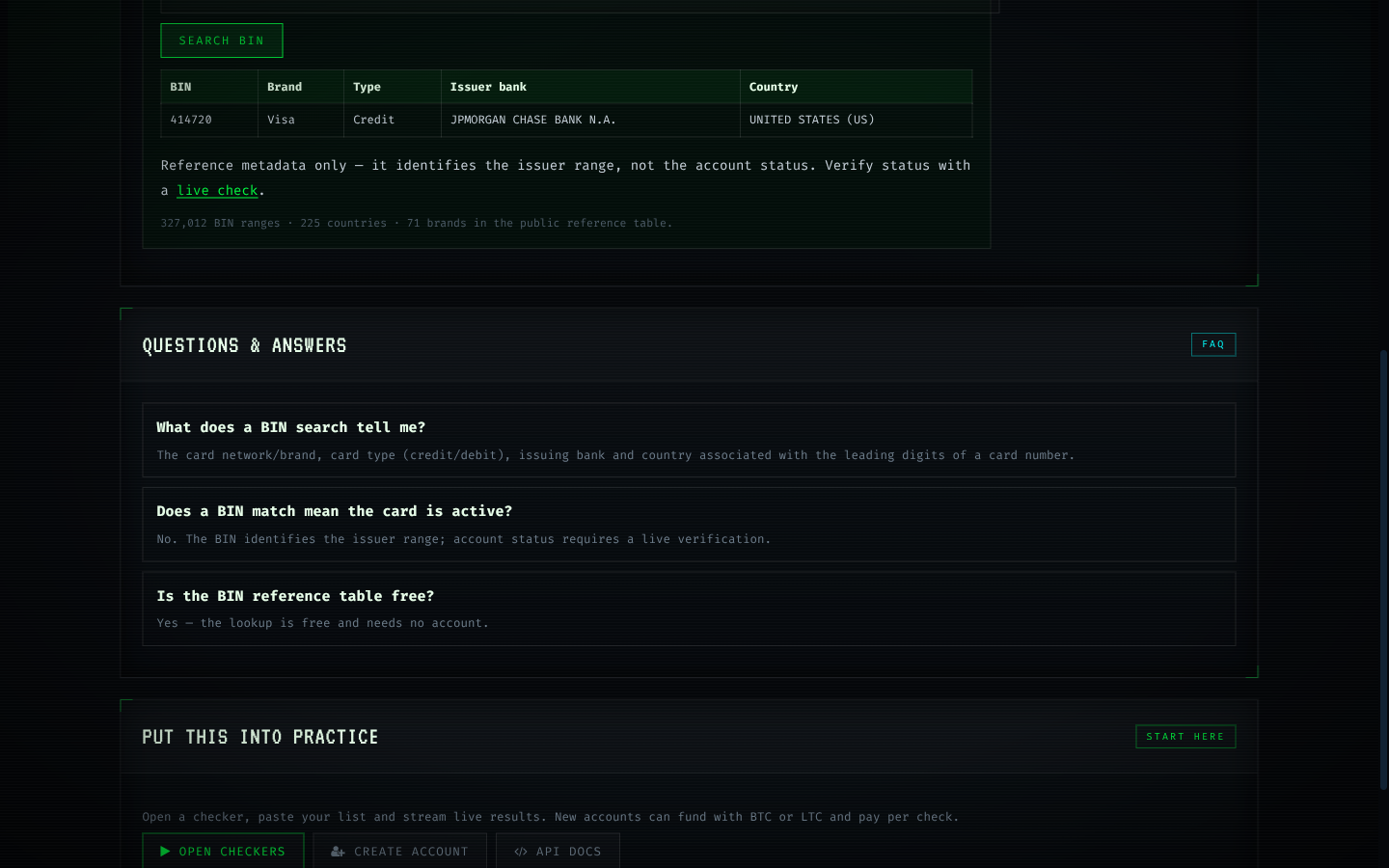
JCB behaviour is shaped by both the network and the issuing bank, which is why two cards with the same brand can resolve differently. Reference metadata for JCB tells you the issuer and type; only a live check reveals whether the account is active. The reference data holds JCB ranges across many issuing banks, and the BIN tools expose them directly. When a JCB check returns error, suspect the format or the route first — the card is still unclassified. Remember it the next time JCB card checking produces an ambiguous answer.
Issuer metadata around JCB card checking
Analysts use BIN distributions to spot shifts in a portfolio long before individual results would show them. Because BIN data is public reference material, it is safe to cache, but it should be re-validated periodically. Six digits usually identify the institution; eight add the program or product level on many ranges. The reference table holds hundreds of thousands of issuer ranges, and the tools expose it without any account-status claims. The habit costs nothing and removes a recurring class of mistakes.
Putting JCB card checking to work
Validate checksums and expiry dates before any paid request; the free browser tools exist precisely so malformed rows never reach a provider. Log request identifiers and outcomes, never full card numbers. Debugging rarely needs a PAN, and storing one is a liability. When results look wrong, diagnose in order: input format, route, provider health, and only then the cards themselves. Watch two numbers over time: the classified rate and the error rate. Together they explain almost every surprise in monthly spend. Remember it the next time JCB card checking produces an ambiguous answer.
What each JCB card checking outcome commits you to
A result is only as fresh as its timestamp. High-value decisions should use checks that ran close to the moment of the decision. Classified rate is the share of cards that produce a definitive answer; it is the first number to compare when switching gateways. The honest reading of unknown is "no answer yet". The card is neither good nor bad, and the remedy is a different route, not a repeat of the same one. Two metrics describe any run: how many cards classify, and how long the pass takes. Everything else is commentary. Holding that line is what makes JCB card checking reliable over time.
Limits and responsible use of JCB card checking
Check only cards you own or are authorised to process; verification is not a shortcut around cardholder authorization. Operators remain responsible for the legal basis on which they hold and process card data. A check does not move money, does not create a charge and does not touch the cardholder's credit file. Write it down; JCB card checking workflows live and die on small consistencies.
Running JCB card checking as a process
Treat provider outages as routing problems: switch routes, recover the unclassified remainder, keep the answers you already paid for. Document the route, the batch policy and the retry rules next to each production run; six months later that note is the diagnosis. Budget verification against the cost of failure, not against zero; the comparison is what makes spend defensible. Reconcile spend monthly against classified results; the difference between the two numbers is where retries hide. Holding that line is what makes JCB card checking reliable over time.
Where JCB card checking goes wrong
Using BIN reference data as account status in JCB card checking confuses two different questions and produces confident, wrong decisions. Validating after the paid JCB card checking request, rather than before, doubles the cost of bad input. Ignoring the p90 latency of JCB card checking leads to timeouts that look like provider faults.
- Scheduling JCB card checking after the decision it informs removes most of its value.
- Assuming every JCB card checking gateway covers every brand is the fastest way to a list full of errors.
- Running JCB card checking without a fallback means one degraded provider turns an entire batch into unknowns.
- Re-checking live cards during JCB card checking spends balance without changing any decision.
What JCB card checking cannot promise
Verification is at its best when it is boring: a routine status step inside an existing, authorised process. Check only cards you own or are authorised to process; verification is not a shortcut around cardholder authorization. High-value decisions deserve fresh checks; stale results drift as accounts change. Remember it the next time JCB card checking produces an ambiguous answer.
Benchmarks and distribution for JCB card checking
Trends beat snapshots: a classified rate that drifts over weeks says more than any single run's result. The platform publishes outcome distributions and latency percentiles from real traffic, refreshed monthly, precisely so expectations can be calibrated against reality. Sample sizes matter. Small windows produce noisy percentages, which is why published aggregates carry minimum thresholds. Cost per classified card is the honest metric. A cheap-per-request route with a high failure rate is the most expensive option in practice. The habit costs nothing and removes a recurring class of mistakes.