KEY TAKEAWAYS
- The BIN identifies the issuing institution and network, not the account status.
- It cannot tell you whether a card is active.
- BIN data changes constantly as issuers reissue ranges.
- Combine BIN segmentation with live verification for reliable decisions.
- Keep the API key server-side and rotate it on any suspicion of exposure.
- AVS adds a second dimension where the route supports it.
Every card number begins with a Bank Identification Number (BIN), also called an Issuer Identification Number (IIN). The first six to eight digits identify the institution that issued the card. BIN data is the backbone of routing, analytics and many fraud controls.
What a BIN reveals
- Issuer: which bank or fintech issued the card.
- Brand and product: Visa, Mastercard, Amex, and often debit, credit, prepaid or commercial.
- Country and currency: the issuer's home region, useful for cross-border rules.
- Contact details: the bank's phone number for issuer call-backs in some workflows.
What a BIN cannot tell you
The BIN says nothing about the specific account. It cannot tell you whether the card is active, its balance, or whether a charge will be approved. Those questions require verification against the issuer, not a lookup. Treating BIN data as card status is one of the most common mistakes in payment tooling.
Where BIN lookup is used
- Routing: choosing the right processor or currency path.
- Risk rules: flagging mismatches between card country and customer country.
- Analytics: reporting approval rates by issuer, product or region.
- UX: showing the detected card brand while a number is typed.
BIN data goes stale
Issuers continuously reissue ranges and move portfolios between banks. A BIN file that is months old misclassifies new ranges. If issuer accuracy matters to your workflow, refresh your BIN data regularly and verify important cards through a live check.
BIN plus verification
The strongest pattern combines both: use the BIN to segment and route, and use a live check to confirm status. Our checker directory lists available gateways, and every result is stored with the BIN so you can audit behaviour by issuer later.
A BIN lookup turns leading card digits into issuer reference data: brand, card type, issuing bank and country. It is the cheapest kind of intelligence available — no network call to an issuer, no cost per lookup — and it answers a question that verification will never answer: who issued this number, and what kind of card is it?
The discipline is keeping the layers straight. BIN data is reference; live checks are status. A lookup that says "Visa credit from a US bank" is complete in itself, and it says nothing about whether the account is open.
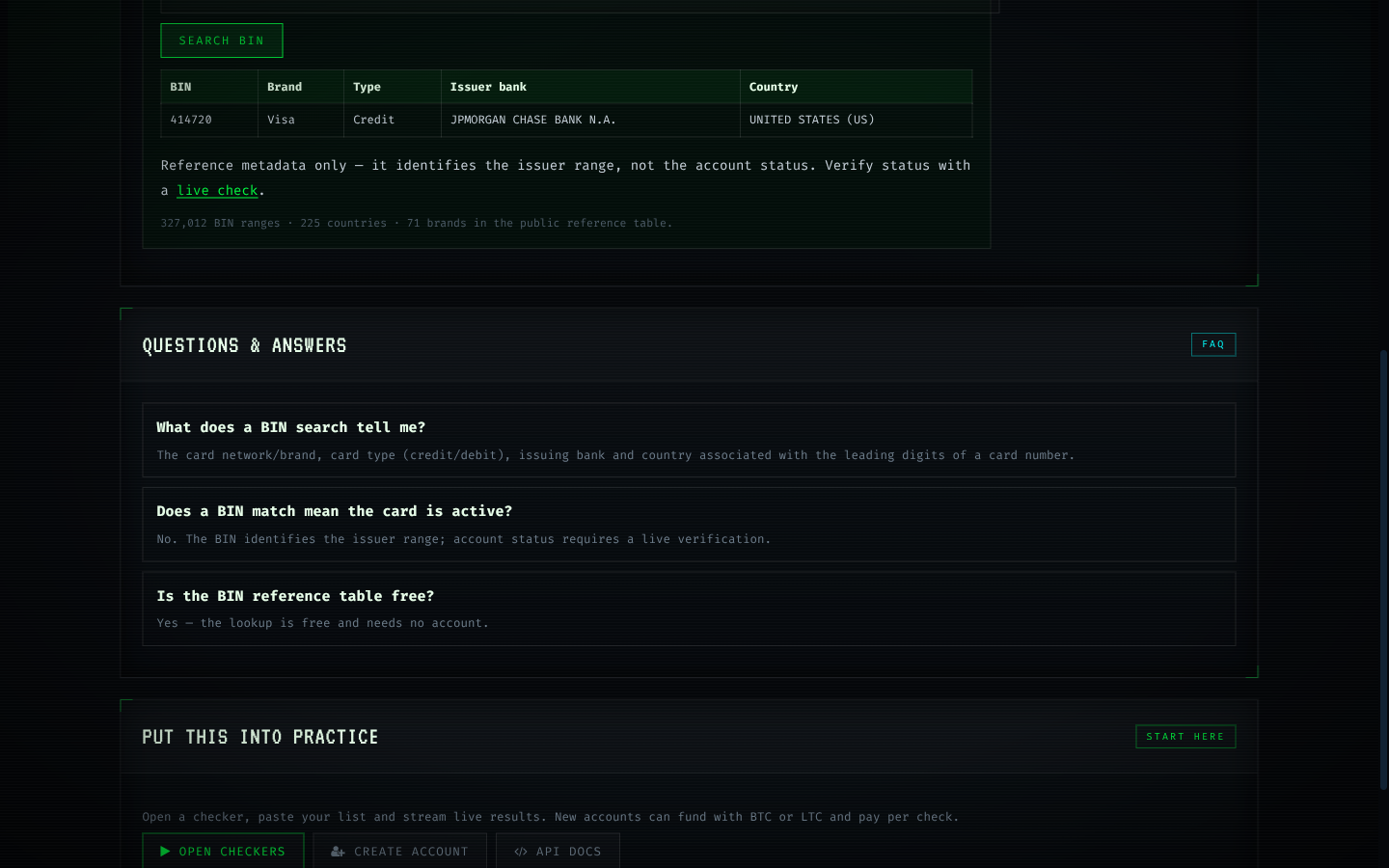
Key points about BIN lookups
- Issuer, brand, type, country — reference data only
- No account-status claims, ever
- Use it for routing, segmentation and display
- Pair with a live check for anything account-dependent
The BIN layer behind BIN lookups
The public BIN endpoint serves the same reference data programmatically, read-only and without card data. BIN metadata complements verification rather than replacing it: reference first, status second. BIN data answers who issued a number and what kind of card it is; status requires a live check. Issuers move portfolios between banks and reissue ranges, so BIN data ages and should be refreshed from maintained sources. It sounds obvious until a real run tests it.
Issuer metadata around BIN lookups
Issuers move portfolios between banks and reissue ranges, so BIN data ages and should be refreshed from maintained sources. BIN data answers who issued a number and what kind of card it is; status requires a live check. The reference table holds hundreds of thousands of issuer ranges, and the tools expose it without any account-status claims. Segmenting by BIN is useful for routing, risk rules and analytics — the places where issuer identity changes behavior. The habit costs nothing and removes a recurring class of mistakes.
Running BIN lookups well: the operating steps
When results look wrong, diagnose in order: input format, route, provider health, and only then the cards themselves. Log request identifiers and outcomes, never full card numbers. Debugging rarely needs a PAN, and storing one is a liability. Size batches to the provider ceiling. Past that line, extra concurrency converts into timeouts rather than throughput. Run one primary gateway with a fallback route. When the primary degrades, re-run only the unclassified remainder on the fallback. In BIN lookups work, that is the difference between a signal and a guess.
Reading BIN lookups results honestly
Classified rate is the share of cards that produce a definitive answer; it is the first number to compare when switching gateways. Errors are free by design: no classification means no charge, so retrying after fixing the cause costs nothing but effort. The honest reading of unknown is "no answer yet". The card is neither good nor bad, and the remedy is a different route, not a repeat of the same one. Dead results are conclusive for the moment and should never be re-checked in the same run; retries on dead cards spend balance for identical answers. Write it down; BIN lookups workflows live and die on small consistencies.
Using BIN lookups on the right side of the line
Where a check is used inside a payment flow, it complements authorization rather than replacing it. Check only cards you own or are authorised to process; verification is not a shortcut around cardholder authorization. Verification is at its best when it is boring: a routine status step inside an existing, authorised process. It is a small rule that changes how BIN lookups behaves at scale.
Tools that make BIN lookups easier
Pair the generator with the Luhn validator when building test fixtures; checksum-valid numbers exercise real validation paths. The CSV cleaner normalises separators and removes duplicates, which is the cheapest way to protect a large run. The test card generator produces checksum-valid numbers for development, and they are never chargeable by design. It is a small rule that changes how BIN lookups behaves at scale.
- Luhn validator
- API integration guide
- how checking works
- What Is A Card Checker
- Merchant Card Validation
- Card Verification Glossary
Running BIN lookups as a process
Schedule recurring checks ahead of the decisions they inform, not after them. Treat provider outages as routing problems: switch routes, recover the unclassified remainder, keep the answers you already paid for. Budget verification against the cost of failure, not against zero; the comparison is what makes spend defensible. Keep one primary gateway and one fallback, and switch on evidence — error spikes and classified-rate drops — rather than on price alone. That single habit separates routine BIN lookups from expensive BIN lookups.
Common mistakes around BIN lookups
Ignoring cost per classified card hides the real price of a cheap BIN lookups route with a high failure rate. Re-checking live cards during BIN lookups spends balance without changing any decision. Validating after the paid BIN lookups request, rather than before, doubles the cost of bad input.
- Assuming every BIN lookups gateway covers every brand is the fastest way to a list full of errors.
- Scheduling BIN lookups after the decision it informs removes most of its value.
- Skipping format validation before BIN lookups turns simple input mistakes into provider rejects that look like card problems.
- Running BIN lookups without a fallback means one degraded provider turns an entire batch into unknowns.
Limits and responsible use of BIN lookups
Results describe the account, never the person; they should inform routing and risk decisions, not identity decisions. Verification is at its best when it is boring: a routine status step inside an existing, authorised process. Where a check is used inside a payment flow, it complements authorization rather than replacing it. In BIN lookups work, that is the difference between a signal and a guess.