KEY TAKEAWAYS
- Maestro uses 5018, 5020, 5038, 5893, 6304, 6759, 6761–6763 with 12–19 digits.
- Security code: 3 digits (back).
- Format checks are free; live status needs an issuer check.
- Validate locally first to avoid spending checks on bad rows.
- AVS adds a second dimension where the route supports it.
- Watch classified rate and latency trends, not just the balance.
Every network has its own number format — Maestro included. This page covers the format facts you need for correct validation, and how to verify live status beyond the format.
Maestro format at a glance
| Property | Value |
|---|---|
| Prefix / IIN ranges | 5018, 5020, 5038, 5893, 6304, 6759, 6761–6763 |
| Number length | 12–19 digits |
| Security code | 3 digits (back) |
| Checksum | Luhn (mod 10) |
What is specific about Maestro
- Maestro is Mastercard’s debit network with highly variable lengths (12–19 digits in some regions), so strict 16-digit validators reject valid numbers.
- Many Maestro cards are PIN-first; online CVV verification support varies by issuer, producing more unknown results.
- The wide prefix list is controlled by Mastercard and changes over time — refresh BIN data regularly.
Validating and verifying
Bulk Maestro lists
Maestro is a debit brand with prefixes across 50, 56–58, 6304, 6759 and 6761–6763. Because it is debit, the practical question shifts from fraud screening toward chargeability: is the account active and likely to accept the intended amount?
Coverage is strong on European providers and patchier elsewhere, and debit routes often require the CVV for a definitive answer. Confirm both before a bulk Maestro run — the difference between a clean list and a page of errors is usually route configuration.

Maestro: coverage, formats and data
Format rules matter for Maestro: prefix, length and security-code conventions must match the gateway before submission. Coverage for Maestro is not uniform across gateways; confirm the route before committing a large list. A pilot batch of Maestro cards before a full run is the cheapest way to confirm coverage. Cross-border Maestro traffic behaves differently from domestic traffic, with more unknowns on the former. The habit costs nothing and removes a recurring class of mistakes.
Issuer metadata around Maestro card checking
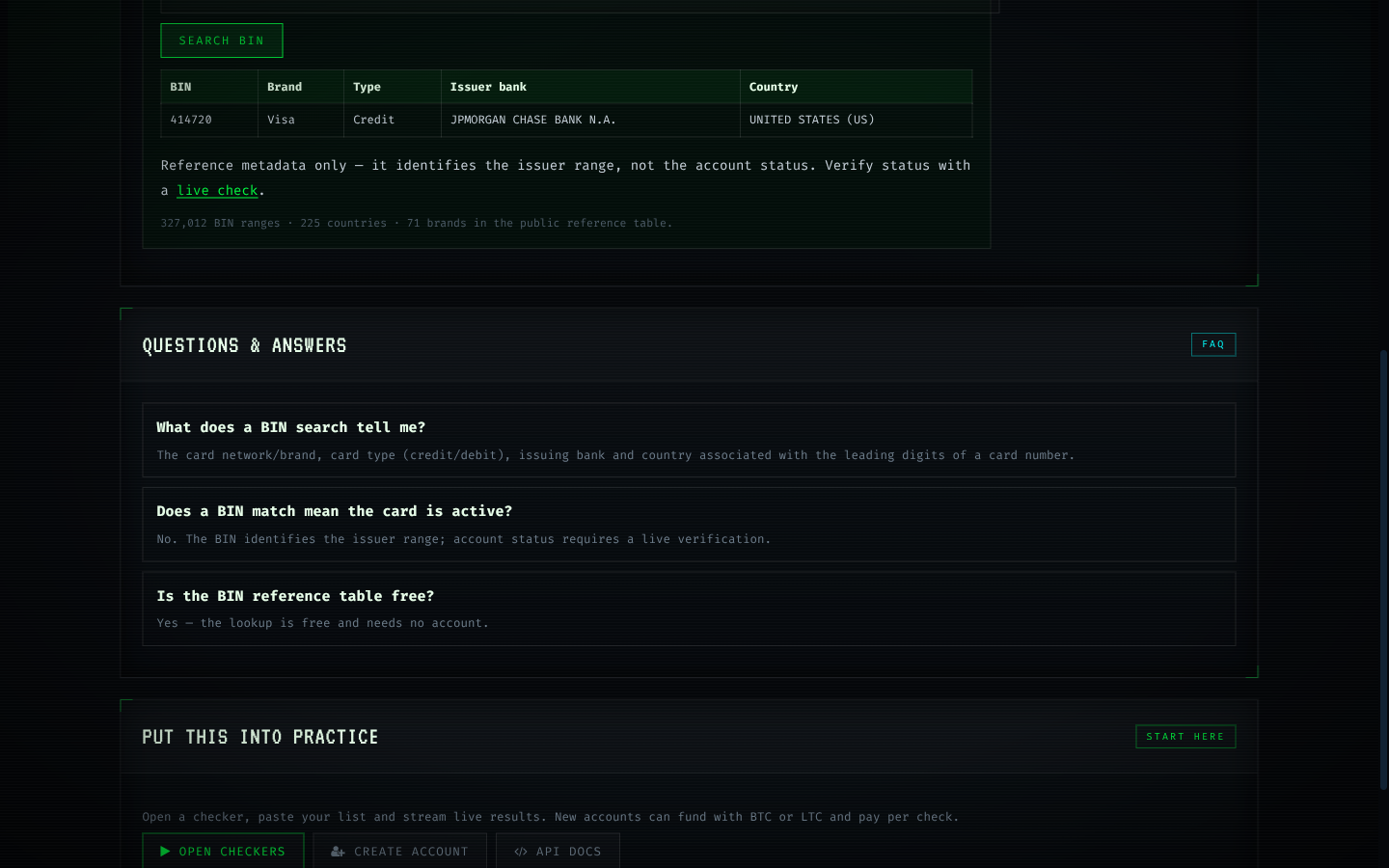
Six digits usually identify the institution; eight add the program or product level on many ranges. BIN metadata complements verification rather than replacing it: reference first, status second. Issuers move portfolios between banks and reissue ranges, so BIN data ages and should be refreshed from maintained sources. The reference table holds hundreds of thousands of issuer ranges, and the tools expose it without any account-status claims. That distinction is what keeps Maestro card checking decisions clean.
Putting Maestro card checking to work
Validate checksums and expiry dates before any paid request; the free browser tools exist precisely so malformed rows never reach a provider. Start with a pilot of fifty cards. It surfaces format mismatches and routing surprises while the cost of being wrong is still measured in cents. Deduplicate before submitting: the same card in a list twice is billed twice if both copies classify. Size batches to the provider ceiling. Past that line, extra concurrency converts into timeouts rather than throughput. The habit costs nothing and removes a recurring class of mistakes.
From Maestro card checking result to decision
Dead results are conclusive for the moment and should never be re-checked in the same run; retries on dead cards spend balance for identical answers. Classified rate is the share of cards that produce a definitive answer; it is the first number to compare when switching gateways. Two metrics describe any run: how many cards classify, and how long the pass takes. Everything else is commentary. When a result contradicts other evidence, re-check once after a reasonable interval rather than assuming the checker is wrong. Write it down; Maestro card checking workflows live and die on small consistencies.
Boundaries of Maestro card checking
Operators remain responsible for the legal basis on which they hold and process card data. Check only cards you own or are authorised to process; verification is not a shortcut around cardholder authorization. A check does not move money, does not create a charge and does not touch the cardholder's credit file. Write it down; Maestro card checking workflows live and die on small consistencies.
Scaling Maestro card checking without surprises
Alert on classified-rate drops, not just on errors; silent degradation is the expensive kind. Schedule recurring checks ahead of the decisions they inform, not after them. Reconcile spend monthly against classified results; the difference between the two numbers is where retries hide. Keep the API key server-side and regenerable; a leaked key is a billing incident as much as a security one. Keep it in mind whenever Maestro card checking results are reviewed.
Where Maestro card checking goes wrong
Comparing Maestro card checking routes on list price instead of classified rate hides the real economics. Ignoring the p90 latency of Maestro card checking leads to timeouts that look like provider faults. Validating after the paid Maestro card checking request, rather than before, doubles the cost of bad input.
- Retrying a dead card during Maestro card checking spends balance for an answer that will not change within the run.
- Validating after the paid Maestro card checking request, rather than before, doubles the cost of bad input.
- Ignoring cost per classified card hides the real price of a cheap Maestro card checking route with a high failure rate.
- Using BIN reference data as account status in Maestro card checking confuses two different questions and produces confident, wrong decisions.
Using Maestro card checking on the right side of the line
Where a check is used inside a payment flow, it complements authorization rather than replacing it. High-value decisions deserve fresh checks; stale results drift as accounts change. The platform does not trade card data, and nothing in the system is designed to bypass a cardholder's consent. Remember it the next time Maestro card checking produces an ambiguous answer.
What aggregate data says about Maestro card checking
When the classified rate moves, the cause is usually a route or provider change rather than the underlying cards. Aggregate numbers describe populations, not individual cards. Use them to size timeouts and retry budgets, never to judge one account. The reference BIN table covers hundreds of thousands of issuer ranges, and it is deliberately separate from account-status data: one describes issuers, the other describes cards. Latency percentiles matter more than averages: the p90 and p99 tell you what a slow run actually feels like. That distinction is what keeps Maestro card checking decisions clean.