KEY TAKEAWAYS
- American Express uses 34 or 37 with 15 digits.
- Security code: 4 digits (front CID).
- Format checks are free; live status needs an issuer check.
- Validate locally first to avoid spending checks on bad rows.
- History retains American Express card checking results for the retention window, then purges them.
- Unknown deserves one fallback pass, not infinite retries.
Every network has its own number format — American Express included. This page covers the format facts you need for correct validation, and how to verify live status beyond the format.
American Express format at a glance
| Property | Value |
|---|---|
| Prefix / IIN ranges | 34 or 37 |
| Number length | 15 digits |
| Security code | 4 digits (front CID) |
| Checksum | Luhn (mod 10) |
What is specific about American Express
- Amex is the only major network with a 15-digit number and a 4-digit security code — validators that assume 16/3 fail on every Amex card.
- The 4-digit CID sits on the front above the number, not in the signature strip.
- Some Amex products are charge cards rather than revolving credit; verification still reports account status the same way.
Validating and verifying
Bulk American Express lists
American Express is unusual among major brands because it issues most of its cards directly, which makes its behavior more consistent than association brands. The format is distinct too: 15 digits, prefixes 34 and 37, and a four-digit CID printed on the front rather than a three-digit code on the back.
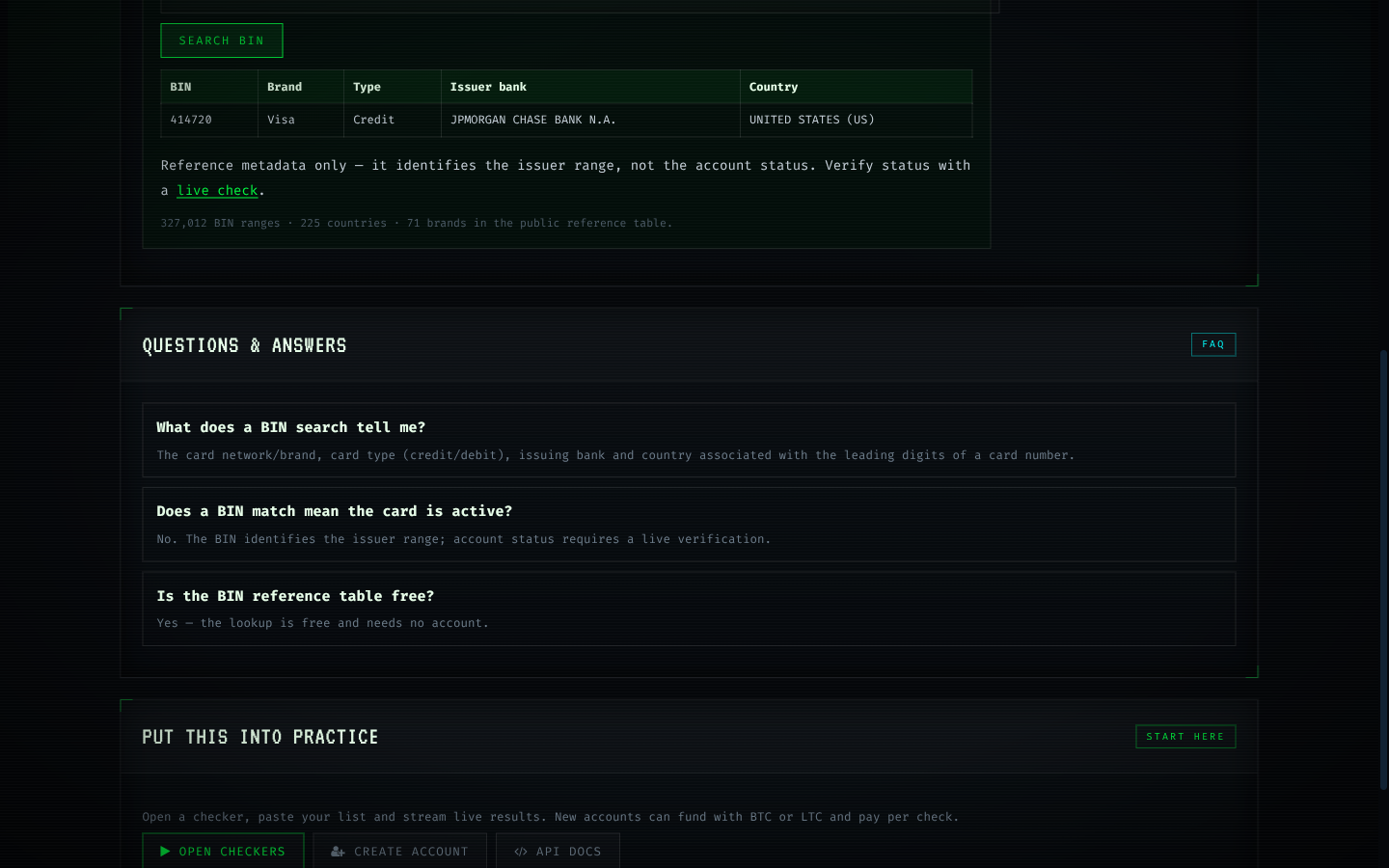
That format is the first thing to verify before any paid check, because Amex requests that reach providers with the wrong shape come back as errors rather than classifications. Coverage is narrower than Visa or Mastercard, so confirm the route accepts Amex before committing a batch.

Checking American Express cards in practice
Coverage for American Express is not uniform across gateways; confirm the route before committing a large list. Cross-border American Express traffic behaves differently from domestic traffic, with more unknowns on the former. Format rules matter for American Express: prefix, length and security-code conventions must match the gateway before submission. A pilot batch of American Express cards before a full run is the cheapest way to confirm coverage. Write it down; American Express card checking workflows live and die on small consistencies.
Issuer metadata around American Express card checking
Issuers move portfolios between banks and reissue ranges, so BIN data ages and should be refreshed from maintained sources. Six digits usually identify the institution; eight add the program or product level on many ranges. Because BIN data is public reference material, it is safe to cache, but it should be re-validated periodically. BIN metadata complements verification rather than replacing it: reference first, status second. It is a small rule that changes how American Express card checking behaves at scale.
Running American Express card checking well: the operating steps
Deduplicate before submitting: the same card in a list twice is billed twice if both copies classify. Keep a small balance buffer so an interrupted run never leaves a half-classified list and the temptation to re-check everything. Treat every large list as two lists: the part that classifies on the first pass, and the remainder that needs a decision about how hard to chase. When results look wrong, diagnose in order: input format, route, provider health, and only then the cards themselves. Holding that line is what makes American Express card checking reliable over time.
Reading American Express card checking results honestly
Dead results are conclusive for the moment and should never be re-checked in the same run; retries on dead cards spend balance for identical answers. Conflating outcomes is the most expensive habit in this area — an error treated as a dead card discards real inventory, and an unknown treated as live inflates confidence. Errors are free by design: no classification means no charge, so retrying after fixing the cause costs nothing but effort. A live answer is evidence about the account, not a guarantee about a specific future transaction; issuer rules can change between the check and the charge. In American Express card checking work, that is the difference between a signal and a guess.
Using American Express card checking on the right side of the line
Verification is a signal, not a guarantee: a live result does not promise that a later charge will be approved. Where a check is used inside a payment flow, it complements authorization rather than replacing it. The platform does not trade card data, and nothing in the system is designed to bypass a cardholder's consent. The habit costs nothing and removes a recurring class of mistakes.
Scaling American Express card checking without surprises
Keep one primary gateway and one fallback, and switch on evidence — error spikes and classified-rate drops — rather than on price alone. Budget verification against the cost of failure, not against zero; the comparison is what makes spend defensible. Document the route, the batch policy and the retry rules next to each production run; six months later that note is the diagnosis. A written triage table — one action per result class — keeps large runs mechanical and auditable. Remember it the next time American Express card checking produces an ambiguous answer.
Failure modes to design out of American Express card checking
Treating an error as a dead card in American Express card checking throws away cards that were never classified, and errors are the cheapest outcomes to recover. Skipping format validation before American Express card checking turns simple input mistakes into provider rejects that look like card problems. Retrying a dead card during American Express card checking spends balance for an answer that will not change within the run.
- Scheduling American Express card checking after the decision it informs removes most of its value.
- Re-checking live cards during American Express card checking spends balance without changing any decision.
- Running American Express card checking without a fallback means one degraded provider turns an entire batch into unknowns.
- Running American Express card checking without a written triage rule turns a clean batch into manual archaeology.
Boundaries of American Express card checking
Check only cards you own or are authorised to process; verification is not a shortcut around cardholder authorization. When a proposed use cannot be explained to a compliance reviewer in one sentence, it is probably not a fit. The platform does not trade card data, and nothing in the system is designed to bypass a cardholder's consent. That single habit separates routine American Express card checking from expensive American Express card checking.