KEY TAKEAWAYS
- Most failures are input or transport, not card problems.
- Clean input before blaming the gateway.
- Errors are unclassified and not billed.
- Unknown is a card outcome, not a failure.
- Unknown deserves one fallback pass, not infinite retries.
- History retains check-failure diagnosis results for the retention window, then purges them.
A failed check is a failed request, not a failed card. Separating those two ideas is the whole diagnosis.
Input failures
Malformed rows, wrong separators, expired dates and Luhn failures never reach the issuer. They are the easiest and most common failures — clean your list first.
Network failures
Timeouts, connection resets and 5xx responses are transport problems. The card is unclassified, not dead; the platform retries on fallback where configured.
Provider failures
Gateway congestion — too many requests in flight — shows up as clustered timeouts. Lower concurrency and watch errors fall.
Ambiguous issuer answers
Unknown results are card-side outcomes (challenges and risk rules), not failures. Retry on a different gateway and treat as its own category.
Next step
A check is a snapshot, and snapshots age. The value of check-failure diagnosis comes from running it at the right moment, not from running it constantly. For payment and risk teams, check-failure diagnosis sits between suspicion and action — the step that turns a hunch about a card into a fact. The useful question is never "can we check this card" but "what changes in our workflow depending on the answer". Operational discipline around check-failure diagnosis shows up in small places: deduplicated inputs, sized batches, and a clear owner for unclassified results.
Checks are routed through providers rather than card networks directly, so the same card can behave differently on different routes. Live means the issuer answered and the account is active and chargeable at that moment; it is strong evidence, not a promise about a future charge. Behind the scenes, every check follows the same chain: your input, the gateway format, the provider connection, the issuer response and the classification you see. That single habit separates routine check-failure diagnosis from expensive check-failure diagnosis.
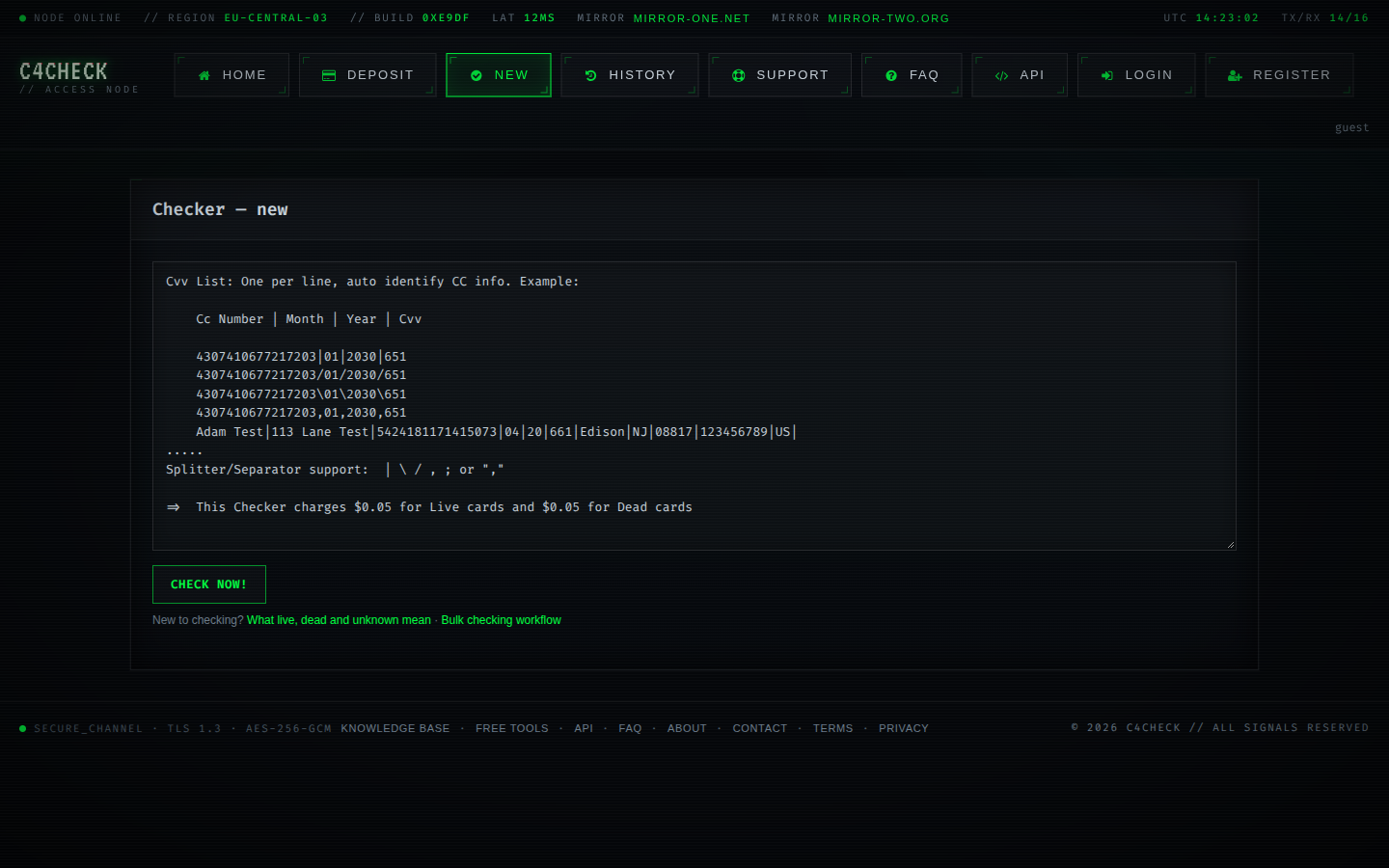
Dead means the account is closed, blocked or invalid. It is a final answer for the current state of the card and should never be retried blindly. A verification answer reflects the issuer's view at the moment of the request; nothing about it changes the card, the account or the cardholder. Nothing in the check moves money: the request asks a question, the issuer answers, and the platform records one of four outcomes against your account. Error means the check itself failed technically: a timeout, a provider fault or malformed input. No classification was produced, and no charge applies. It is a small rule that changes how check-failure diagnosis behaves at scale.
From check-failure diagnosis result to decision
Classified rate is the share of cards that produce a definitive answer; it is the first number to compare when switching gateways. Conflating outcomes is the most expensive habit in this area — an error treated as a dead card discards real inventory, and an unknown treated as live inflates confidence. When a result contradicts other evidence, re-check once after a reasonable interval rather than assuming the checker is wrong. Dead results are conclusive for the moment and should never be re-checked in the same run; retries on dead cards spend balance for identical answers. Holding that line is what makes check-failure diagnosis reliable over time.
Running check-failure diagnosis well: the operating steps
Keep a small balance buffer so an interrupted run never leaves a half-classified list and the temptation to re-check everything. Decide how each outcome is handled before the run starts; a triage plan written after the results arrive is usually just a spreadsheet. Watch two numbers over time: the classified rate and the error rate. Together they explain almost every surprise in monthly spend. For recurring workloads, schedule the run before the moment the answer is needed — ahead of a billing cycle, a payout batch or an onboarding window. It sounds obvious until a real run tests it.
Using check-failure diagnosis on the right side of the line
Verification is a signal, not a guarantee: a live result does not promise that a later charge will be approved. Verification is at its best when it is boring: a routine status step inside an existing, authorised process. Check only cards you own or are authorised to process; verification is not a shortcut around cardholder authorization. That distinction is what keeps check-failure diagnosis decisions clean.
Inside check-failure diagnosis: what happens on a check
A check sends an authorization-shaped request through a provider to the issuer and classifies the reply into one of four states: live, dead, unknown or error. Checks are routed through providers rather than card networks directly, so the same card can behave differently on different routes. A verification answer reflects the issuer's view at the moment of the request; nothing about it changes the card, the account or the cardholder. Rate limits, formats and latency all come from the provider side, which is why per-gateway configuration exists instead of one global setting. In check-failure diagnosis work, that is the difference between a signal and a guess.
What aggregate data says about check-failure diagnosis
The platform publishes outcome distributions and latency percentiles from real traffic, refreshed monthly, precisely so expectations can be calibrated against reality. Sample sizes matter. Small windows produce noisy percentages, which is why published aggregates carry minimum thresholds. Cost per classified card is the honest metric. A cheap-per-request route with a high failure rate is the most expensive option in practice. Trends beat snapshots: a classified rate that drifts over weeks says more than any single run's result. That distinction is what keeps check-failure diagnosis decisions clean.
Scaling check-failure diagnosis without surprises
Document the route, the batch policy and the retry rules next to each production run; six months later that note is the diagnosis. Treat provider outages as routing problems: switch routes, recover the unclassified remainder, keep the answers you already paid for. Track cost per classified card rather than cost per request; it is the only metric that reflects retries and unknown rates. Schedule recurring checks ahead of the decisions they inform, not after them. That single habit separates routine check-failure diagnosis from expensive check-failure diagnosis.
Failure modes to design out of check-failure diagnosis
Retrying a dead card during check-failure diagnosis spends balance for an answer that will not change within the run. Validating after the paid check-failure diagnosis request, rather than before, doubles the cost of bad input. Skipping format validation before check-failure diagnosis turns simple input mistakes into provider rejects that look like card problems.
- Assuming every check-failure diagnosis gateway covers every brand is the fastest way to a list full of errors.
- Treating an error as a dead card in check-failure diagnosis throws away cards that were never classified, and errors are the cheapest outcomes to recover.
- Running check-failure diagnosis without a written triage rule turns a clean batch into manual archaeology.
- Scheduling check-failure diagnosis after the decision it informs removes most of its value.