KEY TAKEAWAYS
- Node 18+ needs no dependencies to call the API.
- Bound concurrency with a simple worker pool.
- Retry transient errors with exponential backoff and jitter.
- Keep raw responses for audits; never log card data.
- Unknown deserves one fallback pass, not infinite retries.
- A 50-card pilot removes most the Node.js integration surprises for cents.
Node 18+ ships fetch, so no dependencies are needed to call the card checker API.
Basic client
const API_URL = 'https://c4check.com/api/v1/api.php';
const API_KEY = process.env.CARD_CHECKER_API_KEY;

async function checkCard(card, gateway) {
  const url = new URL(API_URL);
  url.searchParams.set('gateway', gateway);
  url.searchParams.set('cc', card);
  url.searchParams.set('json', '1');

  const res = await fetch(url, {
    headers: { 'X-API-Key': API_KEY },
    signal: AbortSignal.timeout(60000),
  });
  if (!res.ok) throw new Error('HTTP ' + res.status);
  return res.json();
}
Bounded concurrency for batches
async function runBatch(cards, gateway, limit = 5) {
  const out = [];
  const queue = [...cards];
  await Promise.all(Array.from({ length: limit }, async () => {
    while (queue.length) {
      const card = queue.shift();
      try { out.push(await checkCard(card, gateway)); }
      catch (e) { out.push({ card, status: false, error: String(e) }); }
    }
  }));
  return out;
}
Retry with backoff and jitter
async function withRetry(fn, tries = 3) {
  for (let i = 0; ; i++) {
    try { return await fn(); }
    catch (e) {
      if (i >= tries) throw e;
      const wait = Math.min(8000, 500 * 2 ** i) * (0.5 + Math.random());
      await new Promise(r => setTimeout(r, wait));
    }
  }
}
Result mapping
Map result to live/dead/unknown and keep the raw response for auditing. A status:false response is never billed — inspect the error and fix configuration rather than retrying blindly. More in error handling and the general integration guide.
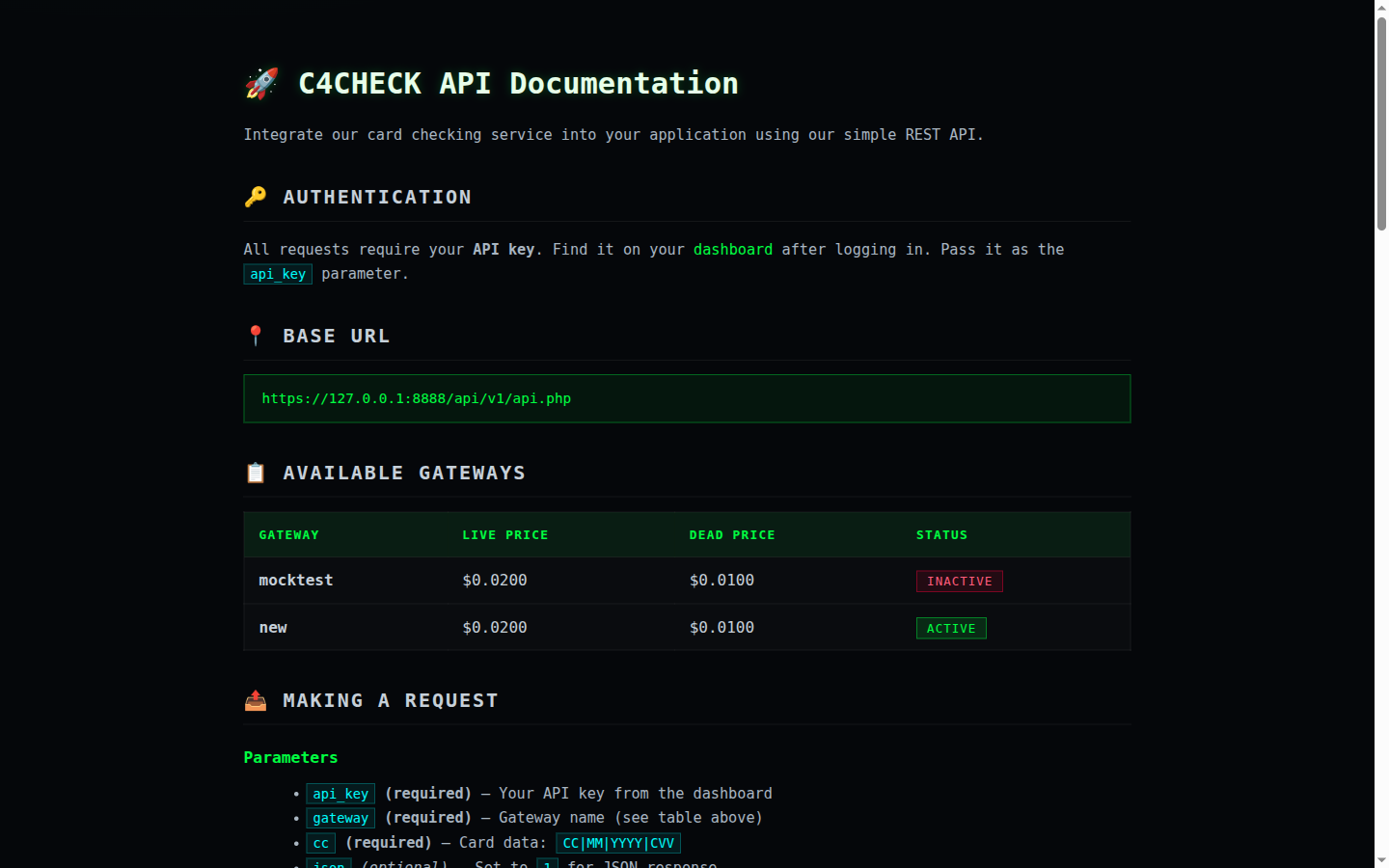
Node integrations usually want two things from the checker API: a promise-friendly client and clean handling of the error class, which produces no classification and no charge. Wrapping the call in a small typed function keeps the four outcomes explicit and makes retries safe to add later.
The sample uses global fetch (Node 18+), reads the key from the environment, and returns a plain object — easy to drop into workers, queues or cron jobs.
The Node.js integration: a working example
const KEY = process.env.C4CHECK_KEY;

export async function check(gateway, card) {
  const u = new URL("https://c4check.com/api/v1/api.php");
  u.searchParams.set("gateway", gateway);
  u.searchParams.set("cc", card);
  u.searchParams.set("json", "1");
  const r = await fetch(u, { headers: { "X-API-Key": KEY } });
  if (!r.ok) throw new Error(`api ${r.status}`);
  return r.json(); // { result, balance, charge }
}
Reconcile timeout outcomes before assuming failure — the answer may exist even when the response did not arrive. Errors produce no classification and no charge, which makes a careful retry strategy effectively free. Branch on the result field rather than the HTTP status alone: a successful response can still carry an error outcome. Write it down; the Node.js integration workflows live and die on small consistencies.
Working with the the Node.js integration integration
Authenticate with the API key in a request header; a key in a URL or in client-side code is a leak waiting to happen. Regenerating the key takes one click on the dashboard and invalidates the old one immediately. Every response returns the current balance and the amount charged, so spend can be tracked without a second call. Branch on the result field rather than the HTTP status alone: a successful response can still carry an error outcome. It is a small rule that changes how the Node.js integration behaves at scale.
Security rules for the Node.js integration
Log identifiers and outcomes, not card numbers. Debugging almost never requires a PAN. API keys are server-side secrets: they belong in environment configuration, never in URLs, logs or client bundles. Encrypted transport and account-scoped access are defaults; nothing about the integration requires changing them. The dashboard shows the key once and lets you rotate it at will; rotation is cheap, leaks are not. It is a small rule that changes how the Node.js integration behaves at scale.
Interpreting outcomes in the Node.js integration
- In the Node.js integration, live results route forward: billing, approval or completion, depending on the workflow.
- Unknown results in the Node.js integration get one fallback pass on a second route, then a defined resting state.
- Dead results in the Node.js integration route to recovery: dunning, an update-payment prompt or list cleanup.
- Errors in the Node.js integration return to the queue after the cause is fixed, because they produced no answer at all.
Conflating outcomes is the most expensive habit in this area — an error treated as a dead card discards real inventory, and an unknown treated as live inflates confidence. Classified rate is the share of cards that produce a definitive answer; it is the first number to compare when switching gateways. Dead results are conclusive for the moment and should never be re-checked in the same run; retries on dead cards spend balance for identical answers. That distinction is what keeps the Node.js integration decisions clean.
Putting the Node.js integration to work
Decide how each outcome is handled before the run starts; a triage plan written after the results arrive is usually just a spreadsheet. When results look wrong, diagnose in order: input format, route, provider health, and only then the cards themselves. Run one primary gateway with a fallback route. When the primary degrades, re-run only the unclassified remainder on the fallback. Size batches to the provider ceiling. Past that line, extra concurrency converts into timeouts rather than throughput. That distinction is what keeps the Node.js integration decisions clean.
Limits and responsible use of the Node.js integration
Where a check is used inside a payment flow, it complements authorization rather than replacing it. The platform does not trade card data, and nothing in the system is designed to bypass a cardholder's consent. Verification is a signal, not a guarantee: a live result does not promise that a later charge will be approved. It sounds obvious until a real run tests it.
Scaling the Node.js integration without surprises
Document the route, the batch policy and the retry rules next to each production run; six months later that note is the diagnosis. Schedule recurring checks ahead of the decisions they inform, not after them. A written triage table — one action per result class — keeps large runs mechanical and auditable. Track cost per classified card rather than cost per request; it is the only metric that reflects retries and unknown rates. In the Node.js integration work, that is the difference between a signal and a guess.
Reading the Node.js integration results honestly
Two metrics describe any run: how many cards classify, and how long the pass takes. Everything else is commentary. A live answer is evidence about the account, not a guarantee about a specific future transaction; issuer rules can change between the check and the charge. The four result classes are a decision matrix, not a score: live proceeds, dead recovers, unknown gets one careful retry, error returns to the queue. When a result contradicts other evidence, re-check once after a reasonable interval rather than assuming the checker is wrong. That single habit separates routine the Node.js integration from expensive the Node.js integration.