KEY TAKEAWAYS
- Each deposit uses a single-use invoice address and a minimum amount.
- Balance credits after network confirmation — not instantly.
- Send the correct coin to the correct invoice.
- Watch the balance returned by the API to avoid dry runs.
- Errors in crypto funding are free: no classification, no charge.
- AVS adds a second dimension where the route supports it.
Checking runs on a prepaid balance: you deposit crypto, the platform credits your account, and every check deducts its cost from the balance. No invoices per run, no card details on file.
The deposit flow
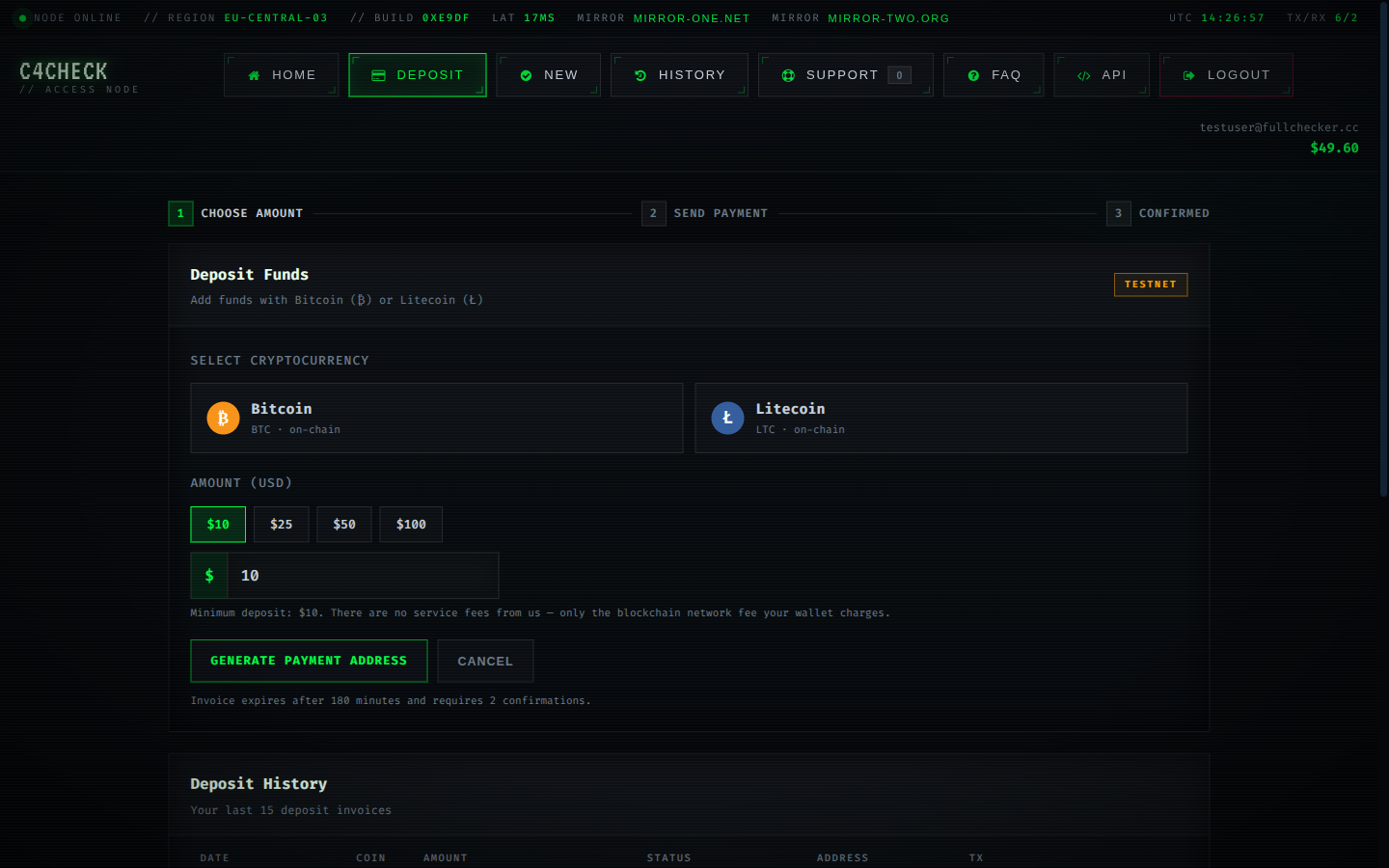
- Open the deposit page and choose BTC or LTC.
- The platform generates a unique invoice address for that deposit.
- Send any amount at or above the displayed minimum from your wallet.
- The network confirms the transaction; the deposit service credits your balance automatically.
Each invoice is single-use and time-limited. If it expires before payment confirms, the funds still arrive — the platform reconciles late payments to the invoice they were sent to.
Why confirmations matter
Blockchains are immutable but not instant. BTC typically needs a few confirmations before funds are considered safe; LTC confirms faster and with lower fees. Your balance updates once the network reaches the confidence threshold — this is normal and not a stuck payment.
Common mistakes
- Wrong coin or network: send BTC to the BTC invoice only. Cross-network sends are not recovered automatically.
- Sending below minimum: small transfers are not credited and network fees make them uneconomical anyway.
- Reusing old addresses: always generate a fresh invoice for each deposit.
- Impatience: an unconfirmed transaction is not lost; it is pending.
Balances, holds and charges
When you start a check, the platform reserves the maximum cost as a hold and settles the exact amount per classified result. If a check fails before producing a result, the hold is released. Every movement — deposit, hold, charge, release — is visible in your history. The FAQ covers billing edge cases.
Keeping a healthy balance
For automation, keep a buffer and watch the balance value returned by the API. An empty balance rejects new checks before spending and the API response tells your integration exactly where it stands.
Funding is crypto-only by design: BTC and LTC deposits keep the entire verification loop free of card-network processing on the platform side. Each deposit generates an address and a QR code, confirmation progress is visible in real time, and the balance credits automatically once the transaction confirms.
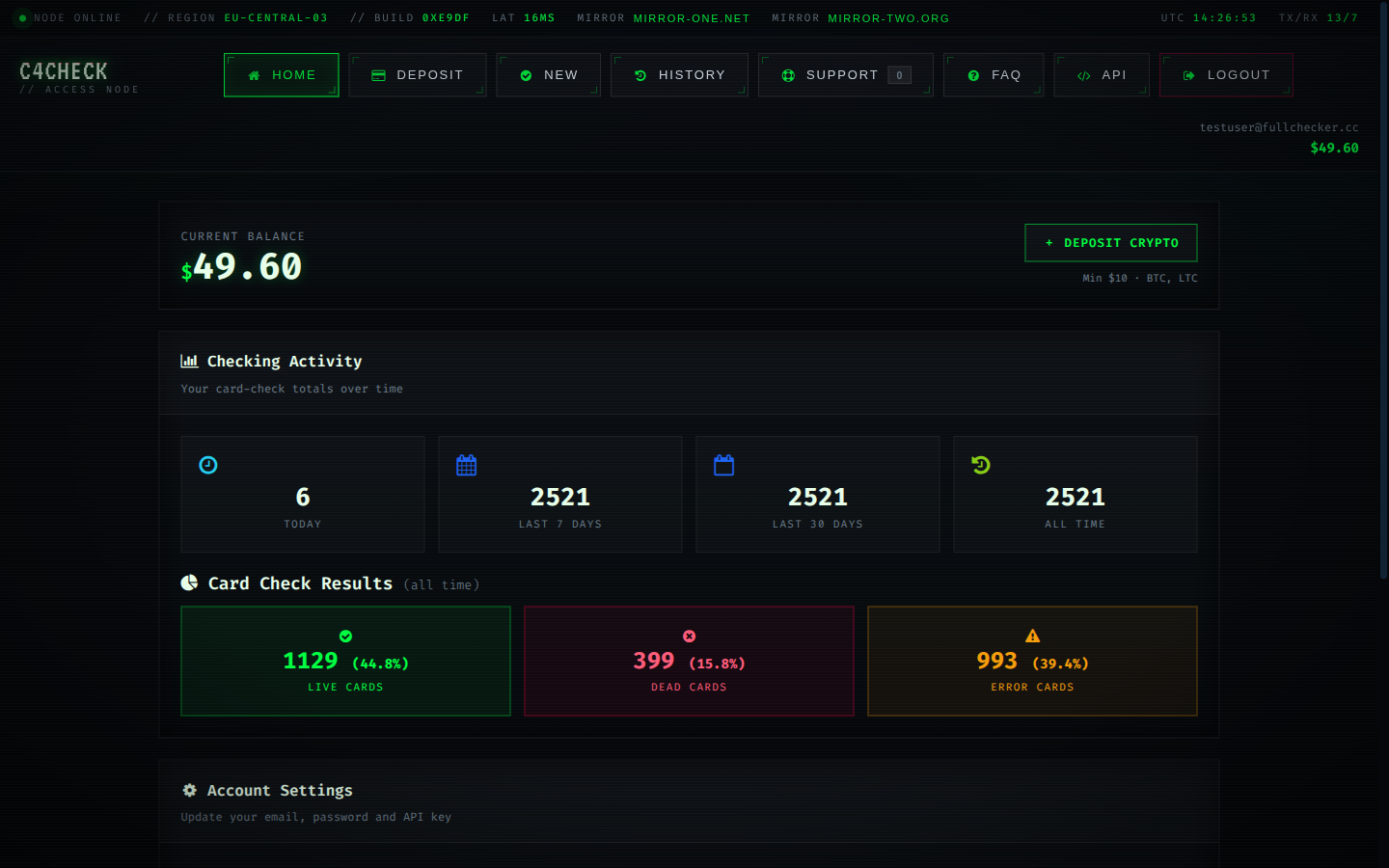
The operational advice is unglamorous: top up before long runs, keep a small buffer so a batch never dies half-classified, and treat confirmation time as part of your planning rather than a surprise. History and the dashboard show spend rates, so top-up sizes can be calculated rather than guessed.
Key points about crypto funding
- BTC and LTC, credited automatically on confirmation
- Deposit before runs; interrupted runs are the expensive kind
- Track spend rate on the dashboard
- Confirmation time is the one variable to plan around
The economics of crypto funding
Top up before long runs; an interrupted run is the most avoidable kind of waste. Funding is prepaid in BTC and LTC; deposits credit automatically once confirmed, and checks draw from the balance per classified result. The API returns the balance on every response, so integrations can meter themselves. Billing follows the classification: live and dead results are billed at the gateway price, while errors are free. That distinction is what keeps crypto funding decisions clean.
A working routine for crypto funding
Start with a pilot of fifty cards. It surfaces format mismatches and routing surprises while the cost of being wrong is still measured in cents. Deduplicate before submitting: the same card in a list twice is billed twice if both copies classify. For recurring workloads, schedule the run before the moment the answer is needed — ahead of a billing cycle, a payout batch or an onboarding window. Validate checksums and expiry dates before any paid request; the free browser tools exist precisely so malformed rows never reach a provider. Remember it the next time crypto funding produces an ambiguous answer.
Running crypto funding as a process
Reconcile spend monthly against classified results; the difference between the two numbers is where retries hide. Treat provider outages as routing problems: switch routes, recover the unclassified remainder, keep the answers you already paid for. Keep the API key server-side and regenerable; a leaked key is a billing incident as much as a security one. A written triage table — one action per result class — keeps large runs mechanical and auditable. Keep it in mind whenever crypto funding results are reviewed.
Boundaries of crypto funding
When a proposed use cannot be explained to a compliance reviewer in one sentence, it is probably not a fit. A check does not move money, does not create a charge and does not touch the cardholder's credit file. The platform does not trade card data, and nothing in the system is designed to bypass a cardholder's consent. That single habit separates routine crypto funding from expensive crypto funding.
Reading crypto funding results honestly
Conflating outcomes is the most expensive habit in this area — an error treated as a dead card discards real inventory, and an unknown treated as live inflates confidence. Classified rate is the share of cards that produce a definitive answer; it is the first number to compare when switching gateways. Dead results are conclusive for the moment and should never be re-checked in the same run; retries on dead cards spend balance for identical answers. The honest reading of unknown is "no answer yet". The card is neither good nor bad, and the remedy is a different route, not a repeat of the same one. Holding that line is what makes crypto funding reliable over time.
Keeping crypto funding secure
Verification data is operational data — treat it with the same care as any other sensitive business record. Regenerate the key the moment compromise is suspected; every check remains attributed in history, so the audit trail survives. Aggregate statistics are computed without exposing individual records, which is why published numbers can be useful without being risky. Check inputs are account-scoped and retained under the platform retention window, then purged by the scheduled cleanup. Write it down; crypto funding workflows live and die on small consistencies.
Failure modes to design out of crypto funding
Running crypto funding without a fallback means one degraded provider turns an entire batch into unknowns. Scheduling crypto funding after the decision it informs removes most of its value. Running crypto funding without a written triage rule turns a clean batch into manual archaeology.
- Treating an error as a dead card in crypto funding throws away cards that were never classified, and errors are the cheapest outcomes to recover.
- Assuming every crypto funding gateway covers every brand is the fastest way to a list full of errors.
- Scheduling crypto funding after the decision it informs removes most of its value.
- Skipping format validation before crypto funding turns simple input mistakes into provider rejects that look like card problems.
What crypto funding cannot promise
Operators remain responsible for the legal basis on which they hold and process card data. Where a check is used inside a payment flow, it complements authorization rather than replacing it. The platform does not trade card data, and nothing in the system is designed to bypass a cardholder's consent. The habit costs nothing and removes a recurring class of mistakes.
From crypto funding result to decision
A result is only as fresh as its timestamp. High-value decisions should use checks that ran close to the moment of the decision. Classified rate is the share of cards that produce a definitive answer; it is the first number to compare when switching gateways. When a result contradicts other evidence, re-check once after a reasonable interval rather than assuming the checker is wrong. Two metrics describe any run: how many cards classify, and how long the pass takes. Everything else is commentary. That distinction is what keeps crypto funding decisions clean.