KEY TAKEAWAYS
- Compare coverage, classification quality, pricing and audit trails.
- Price per classified card, not per request.
- Results are point-in-time — recheck before important charges.
- Every check is stored with gateway, cost and timestamp.
- Generated test numbers are checksum-valid and never chargeable.
- History retains checker selection results for the retention window, then purges them.
Card checkers differ in ways that only show up after you run real lists. Use this checklist before committing.
Coverage
Which brands and regions can it classify? A checker is only as broad as its weakest gateway. See the gateway selection guide.
Quality
Look at the share of definitive results and how the service handles ambiguity: unknown results should be retried via fallback, not written off. Our benchmarks publish real numbers.
Pricing
Billed per classified result, errors free, holds released. Compare cost per classified card, never sticker price per request.
Freshness
Status changes: cards get blocked, reissued or closed. A result is a point-in-time signal. Practical recheck cadence:
- Before each billing cycle for stored cards.
- Before high-value fulfilment.
- Quarterly hygiene passes on dormant accounts.
Audit trail
Every check here is stored with gateway, cost and timestamp in your history — the evidence you need for disputes and finance reconciliation.
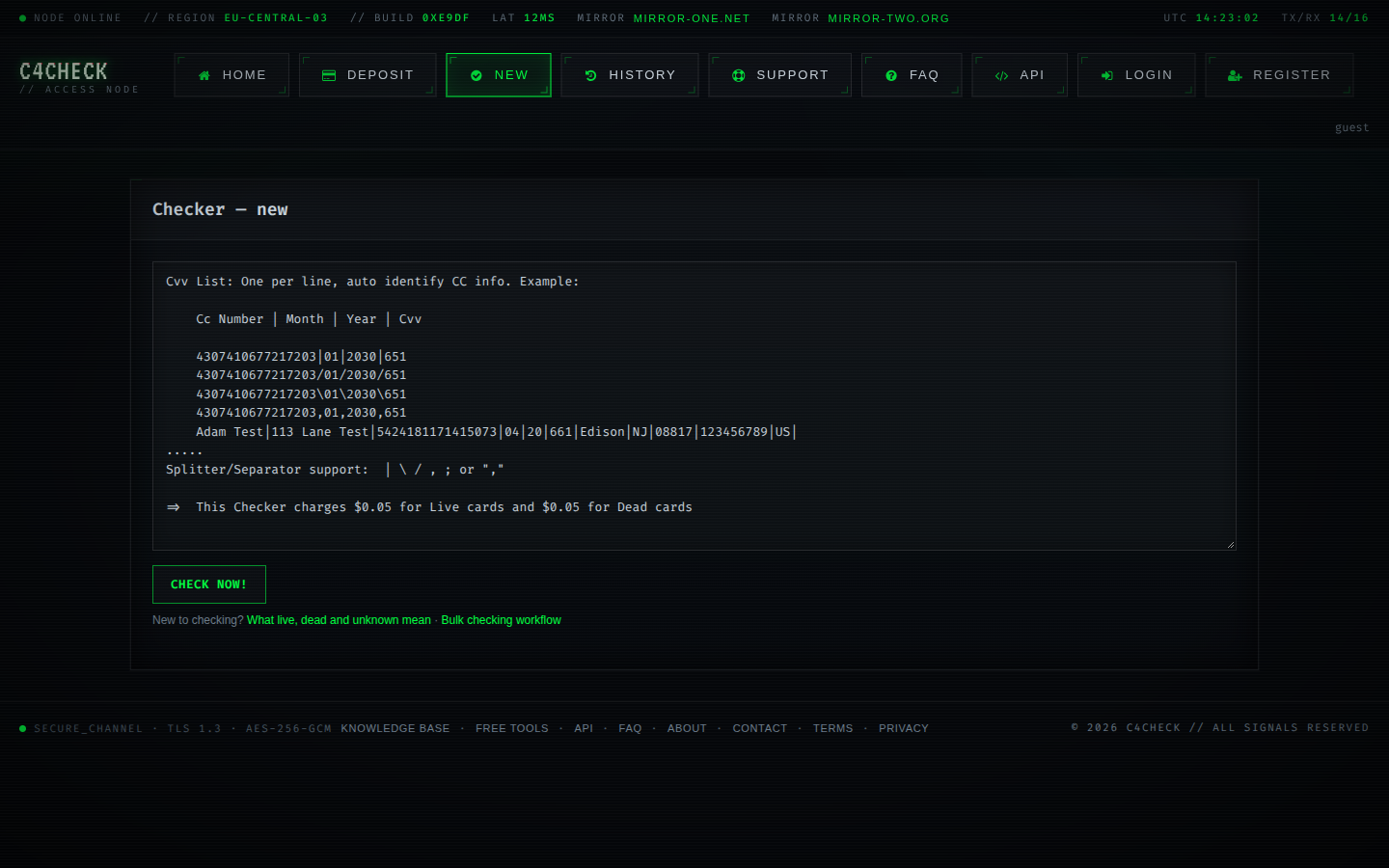
Start with the free format tools, then run a sample list through a checker to compare gateways on your own data.
Choosing a card checker is a procurement decision with a measurable answer: cost per classified card on a representative sample, under realistic concurrency, with a fallback route configured. Everything else — interface design, marketing claims, community reputation — is secondary to that number.
The platform keeps the comparison honest by exposing every variable: per-route pricing, aggregate benchmarks, per-check history and free tools for input preparation. A pilot batch costs cents and replaces speculation with data.
Key points about checker selection
- Define the metric before comparing tools
- Pilot on your own card population
- Account for unknowns and retries, not just list price
- Demand auditable per-check records
The mechanics behind checker selection
Dead means the account is closed, blocked or invalid. It is a final answer for the current state of the card and should never be retried blindly. Nothing in the check moves money: the request asks a question, the issuer answers, and the platform records one of four outcomes against your account. Checks are routed through providers rather than card networks directly, so the same card can behave differently on different routes. Error means the check itself failed technically: a timeout, a provider fault or malformed input. No classification was produced, and no charge applies. It is a small rule that changes how checker selection behaves at scale.
Behind the scenes, every check follows the same chain: your input, the gateway format, the provider connection, the issuer response and the classification you see. Live means the issuer answered and the account is active and chargeable at that moment; it is strong evidence, not a promise about a future charge. The four outcomes are categorical rather than numeric because decisions are categorical too: proceed, recover, retry or log. It is a small rule that changes how checker selection behaves at scale.
Checker selection in practice: a repeatable path
For recurring workloads, schedule the run before the moment the answer is needed — ahead of a billing cycle, a payout batch or an onboarding window. Validate checksums and expiry dates before any paid request; the free browser tools exist precisely so malformed rows never reach a provider. When results look wrong, diagnose in order: input format, route, provider health, and only then the cards themselves. Watch two numbers over time: the classified rate and the error rate. Together they explain almost every surprise in monthly spend. Holding that line is what makes checker selection reliable over time.
Reading checker selection results honestly
Dead results are conclusive for the moment and should never be re-checked in the same run; retries on dead cards spend balance for identical answers. The honest reading of unknown is "no answer yet". The card is neither good nor bad, and the remedy is a different route, not a repeat of the same one. When a result contradicts other evidence, re-check once after a reasonable interval rather than assuming the checker is wrong. Errors are free by design: no classification means no charge, so retrying after fixing the cause costs nothing but effort. It is a small rule that changes how checker selection behaves at scale.
Keeping checker selection predictable
Treat provider outages as routing problems: switch routes, recover the unclassified remainder, keep the answers you already paid for. Budget verification against the cost of failure, not against zero; the comparison is what makes spend defensible. Reconcile spend monthly against classified results; the difference between the two numbers is where retries hide. Document the route, the batch policy and the retry rules next to each production run; six months later that note is the diagnosis. In checker selection work, that is the difference between a signal and a guess.
Using checker selection on the right side of the line
Verification is at its best when it is boring: a routine status step inside an existing, authorised process. Where a check is used inside a payment flow, it complements authorization rather than replacing it. Check only cards you own or are authorised to process; verification is not a shortcut around cardholder authorization. It sounds obvious until a real run tests it.
Funding and costs around checker selection
The real cost metric is cost per classified card, because it folds in retries and unknown rates. A small buffer in the balance buys continuity; running to zero mid-list buys a mess. History records cost and before/after balance for every check, making spend auditable at the individual row. A deposit address is generated per invoice, and confirmation progress is visible in real time on the deposit page. Remember it the next time checker selection produces an ambiguous answer.
Security hygiene around checker selection
Encrypted transport and account-scoped access are defaults; nothing about the integration requires changing them. Log identifiers and outcomes, not card numbers. Debugging almost never requires a PAN. The dashboard shows the key once and lets you rotate it at will; rotation is cheap, leaks are not. API keys are server-side secrets: they belong in environment configuration, never in URLs, logs or client bundles. The habit costs nothing and removes a recurring class of mistakes.
Checker selection in numbers
When the classified rate moves, the cause is usually a route or provider change rather than the underlying cards. Aggregate numbers describe populations, not individual cards. Use them to size timeouts and retry budgets, never to judge one account. Latency percentiles matter more than averages: the p90 and p99 tell you what a slow run actually feels like. The reference BIN table covers hundreds of thousands of issuer ranges, and it is deliberately separate from account-status data: one describes issuers, the other describes cards. It is a small rule that changes how checker selection behaves at scale.
Where checker selection goes wrong
Assuming every checker selection gateway covers every brand is the fastest way to a list full of errors. Validating after the paid checker selection request, rather than before, doubles the cost of bad input. Letting duplicates through the input during checker selection pays twice for the same answer.
- Assuming every checker selection gateway covers every brand is the fastest way to a list full of errors.
- Treating an error as a dead card in checker selection throws away cards that were never classified, and errors are the cheapest outcomes to recover.
- Running checker selection without a written triage rule turns a clean batch into manual archaeology.
- Retrying a dead card during checker selection spends balance for an answer that will not change within the run.
Boundaries of checker selection
When a proposed use cannot be explained to a compliance reviewer in one sentence, it is probably not a fit. Verification is at its best when it is boring: a routine status step inside an existing, authorised process. Check only cards you own or are authorised to process; verification is not a shortcut around cardholder authorization. The habit costs nothing and removes a recurring class of mistakes.
The toolkit around checker selection
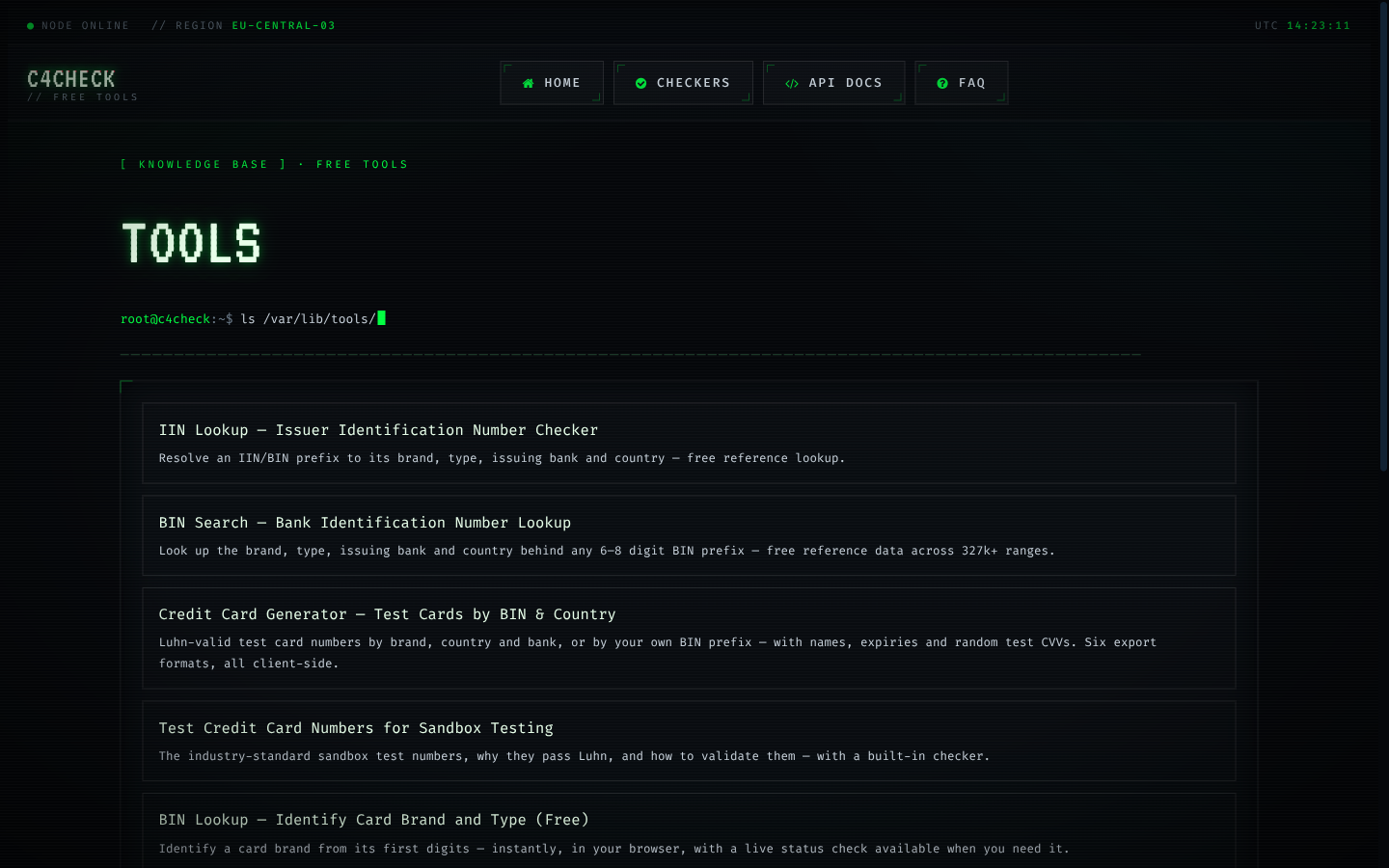
The check-digit calculator shows the Luhn math step by step, useful when building or debugging number generation. The Luhn validator and expiry checker catch format problems before any paid request leaves the browser. BIN search and IIN lookup answer the issuer question — brand, type, bank, country — without touching account status. Remember it the next time checker selection produces an ambiguous answer.